Why did the robot stop? · Part 3 of 8
Environments change. But nobody tells the robot.
Gerben Peeters4 min read
A robot vacuum maps the house once with its laser scanner, and from then on it finds its way by matching what it sees to that map. Then one day the front door stands open. The scanner sees a long open space where the map has a wall, the robot decides this must be the hallway, and off it goes, over the doorstep and down the drive. It was not broken, and it was not unsure: it was perfectly confident where it was. Nobody decided anything about the robot. Somebody opened a door.
Last week we stayed inside the robot: it knew why it could not pick the pallet, and it logged that in a place nobody on the floor was looking. This week is about where the reason came from. It was not in the robot at all. It was in the building around it, and in the people who deliver to it.
Warehouses were not built for robots
Most robots go into a warehouse that already exists. The floor, the racking, the doors, the lighting and the Wi-Fi were laid out for people and forklift drivers, years before anyone thought of an AMR, the autonomous mobile robot that now drives the same aisles. A driver adapts to a cracked floor tile, a rack that sits a little out of line or a pallet that overhangs. A robot works within the margins it was commissioned with, and stops when the world falls outside them.
That is the right thing for it to do. An autonomous forklift with a tonne on its forks cannot afford the vacuum’s confident wrong turn. Stopping is how it protects itself, the pallet and the people around it. The question is what happens after it stops.
The site changes every week, from three directions
The robot learned the site once, at commissioning: the map, the pick and drop positions, the pallet types, the size of a load. The site keeps moving after that, and the changes come from more places than the warehouse itself.
From your own floor. A rack is moved to make room for a promotion. Someone changes a setting on the wrapper. A door that was always closed now stands open in summer, and a scanner sees daylight where it expects a wall.
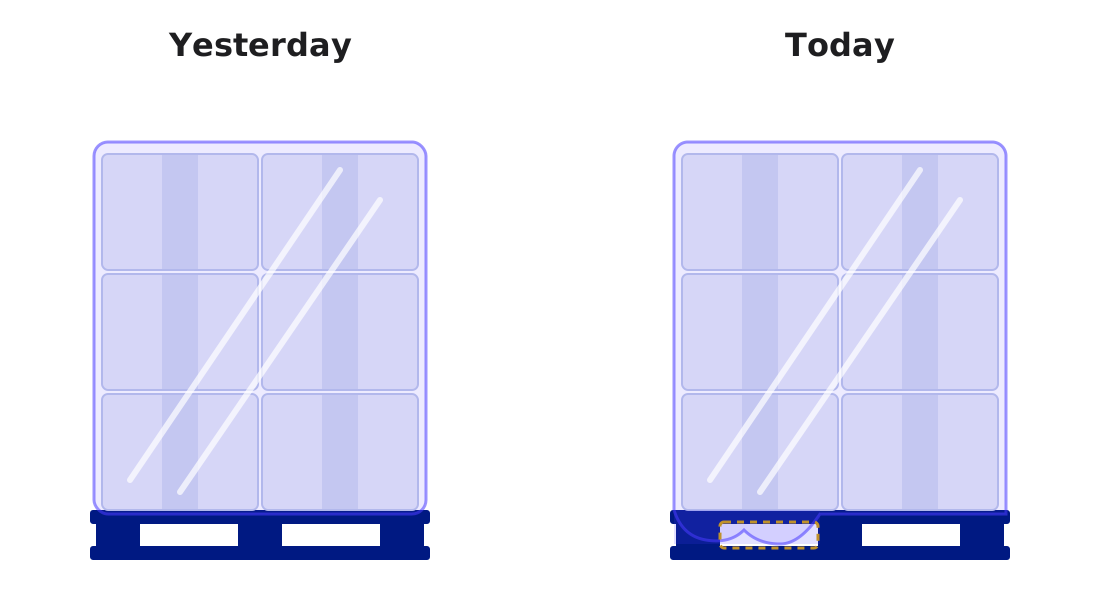
From your suppliers. A new supplier ships on a different pallet. The film from the wrapper comes out a few centimetres wider than yesterday. That is our stop: yesterday the pallets left the wrapper tight to the load, this morning a loose tail of film hung past the edge. A person picking it would not notice. The robot saw a load wider than the one it was taught, and refused.
From your customers. An order mix that shifts to smaller boxes, returns that come back on odd pallets, a packaging spec agreed with a customer that nobody mentioned to operations.
None of these is a decision about the robots, so nobody thinks of telling them. There is usually no place to tell them anyway, short of calling the integrator to adjust the robot’s settings. So the change reaches the robot the hard way, as a stop, often at the start of a shift.
Shit happens. But nobody tells the human either.
Stops will happen. No floor and no robot is perfect, and the people on the floor accept that. What wears them down is not knowing. The operator who walks up to it sees a robot standing still and a pallet that looks normal. They need three things they don’t have: the error within reach, in words they understand, with the context around it. Which robot, which pallet, what it expected, what it saw, and whether the robots behind it are stuck for the same reason or just waiting.
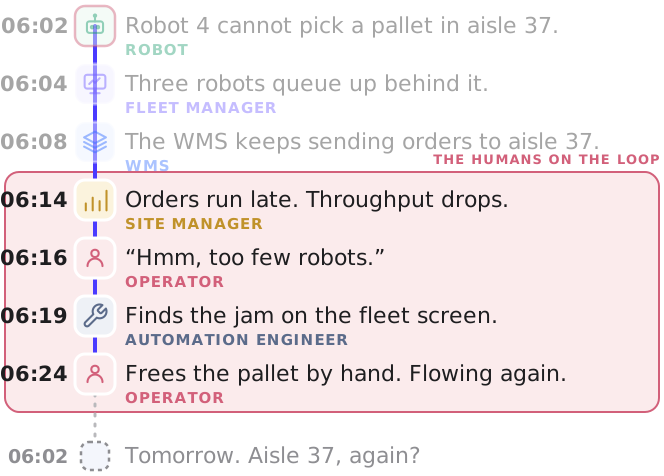
A problem rarely comes alone. That one pallet leaves a trace in five places: the robot’s own log, the fleet manager, the WMS order that went late, the queue behind it, and the operator’s memory of freeing it by hand. Each record is true, and none of them says “the wrapper changed yesterday”.
Clearing the stop is not fixing it
The operator frees the pallet and the flow starts again. From the floor, the problem is solved. The cause is still there: the next pallet off the wrapper has the same tail of film.
So the useful question about a stop is whether it is a one-off or a repeat offender. A one-off needs a quick fix and nothing more. A repeat offender needs someone to find the change behind it and fix that, whether it is a wrapper setting, a pallet spec or a rack. To tell the two apart you need the stops of last week next to the stops of today, in one place, in one language.
The robot was right to stop, and the operator was right to free the pallet. The WMS, meanwhile, kept sending orders to that aisle the whole time.
Next week, we’ll dive deeper into all the parts of a typical automation ecosystem in which the robot operates.