Why did the robot stop? · Part 4 of 8
The best products might not be the best team players
Gerben Peeters5 min read


Would you rather have a team of eleven Cristiano Ronaldos or eleven Lionel Messis? Ask it at a party and most people pick Messi, the better team player, and the numbers back that up as far as numbers can: Ronaldo has scored more goals than anyone, Messi has given more assists than anyone (985 against 936 goals and 419 against 269 assists, according to beIN Sports at the end of October, and the assist count depends on who counts).
Nobody builds a team like that, of course. You put Courtois in goal, the best defenders in front of him, De Bruyne in midfield and Messi or Ronaldo up front, and then you find out that the best player in every position is still not a team. Belgium had exactly that for a decade, number one in the FIFA ranking for years, and never won a tournament. PSG bought Messi, Neymar and Mbappé, the three best attackers in the world, and never won the Champions League with them, then won it in 2025 with none of the three, 5-0 in the final, under a coach who made eleven players play as one.
Most automated warehouses are put together like PSG before 2025, the best player in every position and nobody who makes them play together, which is what this post is about. Last week the robot stopped because the building around it had changed. This week is about the other players on the floor, the WMS, the fleet manager, the conveyors and the ERP, and what each of them was doing while the robot stood in the aisle.
You bought the best player in every position, and that was the right call
Walk around an automated floor and every system you see was the best one for its job on the day it was bought. The robot came out of a comparison on picks per hour, pallet types and safety. The WMS, the warehouse management system that hands out the orders, won on orders per minute and on how well it fits the ERP. The conveyor, the wrapper, the fleet manager, the production system next door, each came with its own spec, its own supplier and its own acceptance test, and each passed. That is a sensible way to buy (I would do it the same way), because nobody can test the team before it exists, so you buy the best player for every position and hope.
Each of them is playing its own match
Here is our stop again, this time from the systems’ side of the floor. The robot refused the pallet and wrote down why, in its own log. The fleet manager, the robot vendor’s software that assigns the missions, saw a robot that was not moving and stopped the robots behind it, which is what it is for. The WMS kept sending orders into that aisle, because by its own numbers nothing was wrong, every order was released on time, and the aisle has no status in the WMS to begin with. It is the midfielder who keeps playing the ball into the box, a perfect pass every time, but irrelevant, because nobody told him the striker went down.
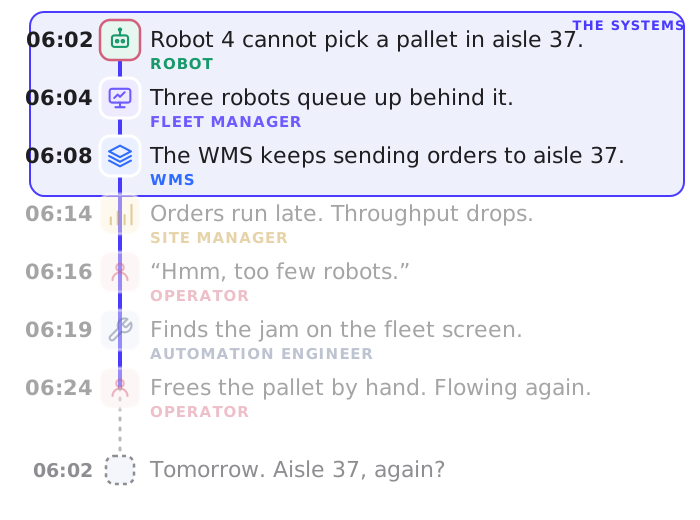
The site manager’s dashboard counted throughput, correctly, and showed it falling. The production line kept producing onto a conveyor that was filling up. Every system did its job by its own numbers that morning, and the match was lost anyway, in the sense that orders ran late and an operator spent twenty minutes freeing a pallet by hand.
Sites build the web one pair at a time
For a long time this worked, because automation lived behind a fence and the systems were stacked in a pyramid. The ERP passed orders to the WMS, the WMS to the fleet manager, the fleet manager to the robots, one direction, down. Nothing on the floor changed from one week to the next, so nothing needed to flow back up.
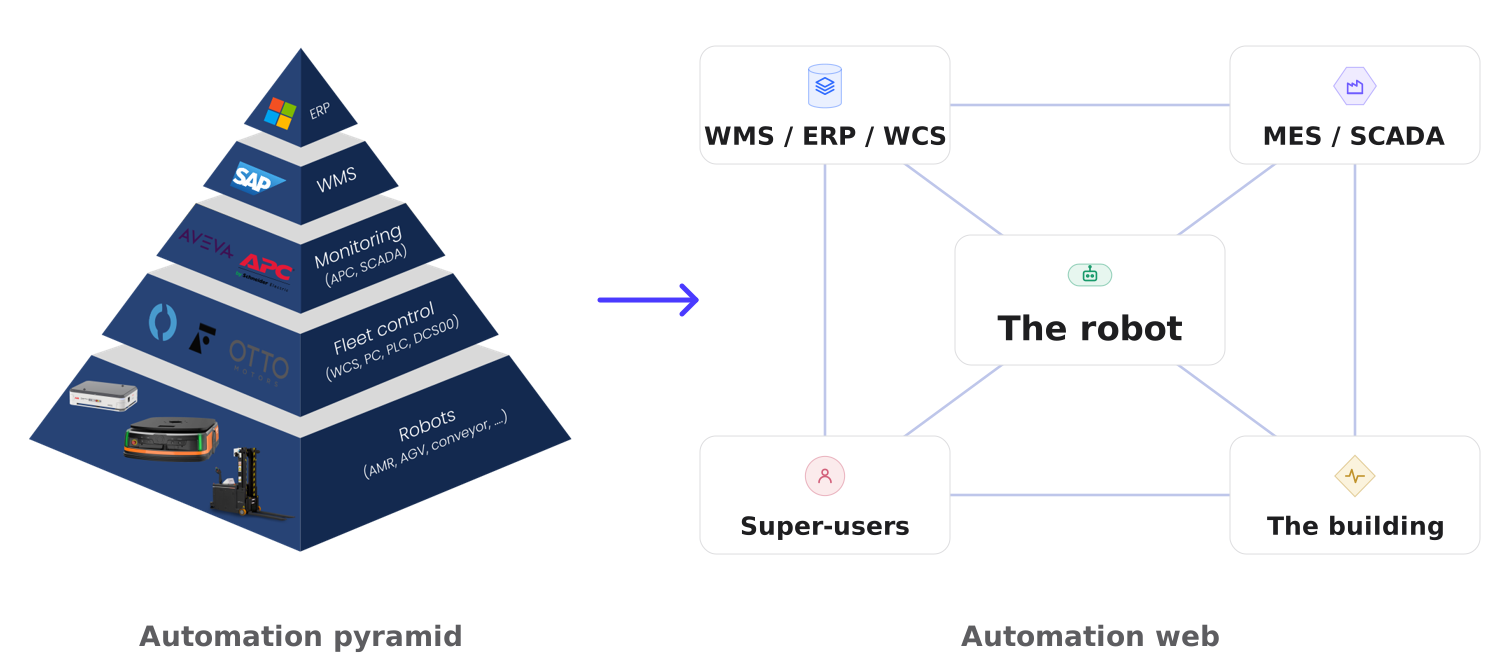
Mobile robots took the fence away, and the pyramid became a web. The robot needs to know what the building is doing, the WMS needs to know what the robot is doing, and the production line needs to know whether the robot is coming. Most sites build that web one pair at a time. An integrator writes a link between the WMS and the fleet manager, another between the fleet manager and the dock door, a third between the conveyor and the WMS, and after weeks of testing each link does exactly what it should. Each link knows its own two systems and nothing else, so the door opens on time for a robot that is stuck behind the stopped one, and a fix in one pair breaks the timing in another (each fix is right for its pair and wrong for the rest). Swap a robot brand and the links are written again. The arithmetic is against you too: five systems make ten pairs, ten systems make 10 x 9 / 2 = 45, and most of those pairs never get a link at all, which is why the WMS still does not hear about the aisle.
The best players play fine with a coach
You do not have to sell your Courtois, what a team of individually brilliant players needs is a coach, the Luis Enrique of your floor, someone who sees the whole pitch, who listens to every player and tells each of them what they need to hear rather than everything. On the floor that means the WMS hears that the aisle is blocked and releases its orders elsewhere, the operator hears which pallet and what the robot saw, the site manager hears why throughput dropped, each in their own words, and each system keeps doing what it was bought for.
That is the spot ROCO takes, between the systems a site already runs. Each of them connects once, and ROCO tells each what the others are doing. How it does that is for part 8 of this series, so for now I leave it at this. The Messis exist as well, systems that are built to pass, with open interfaces like VDA 5050 for the robots, and they make the coach’s job easier, but most floors today are a team of individual stars, and with a coach that is fine.
Next week, the people on the floor, who were playing a match of their own that morning: the operator, the automation engineer and the site manager, and why they do not resist robots, they resist not understanding them.