Why did the robot stop? · Part 5 of 8
People don't resist robots. They resist not understanding them
Gerben Peeters6 min read
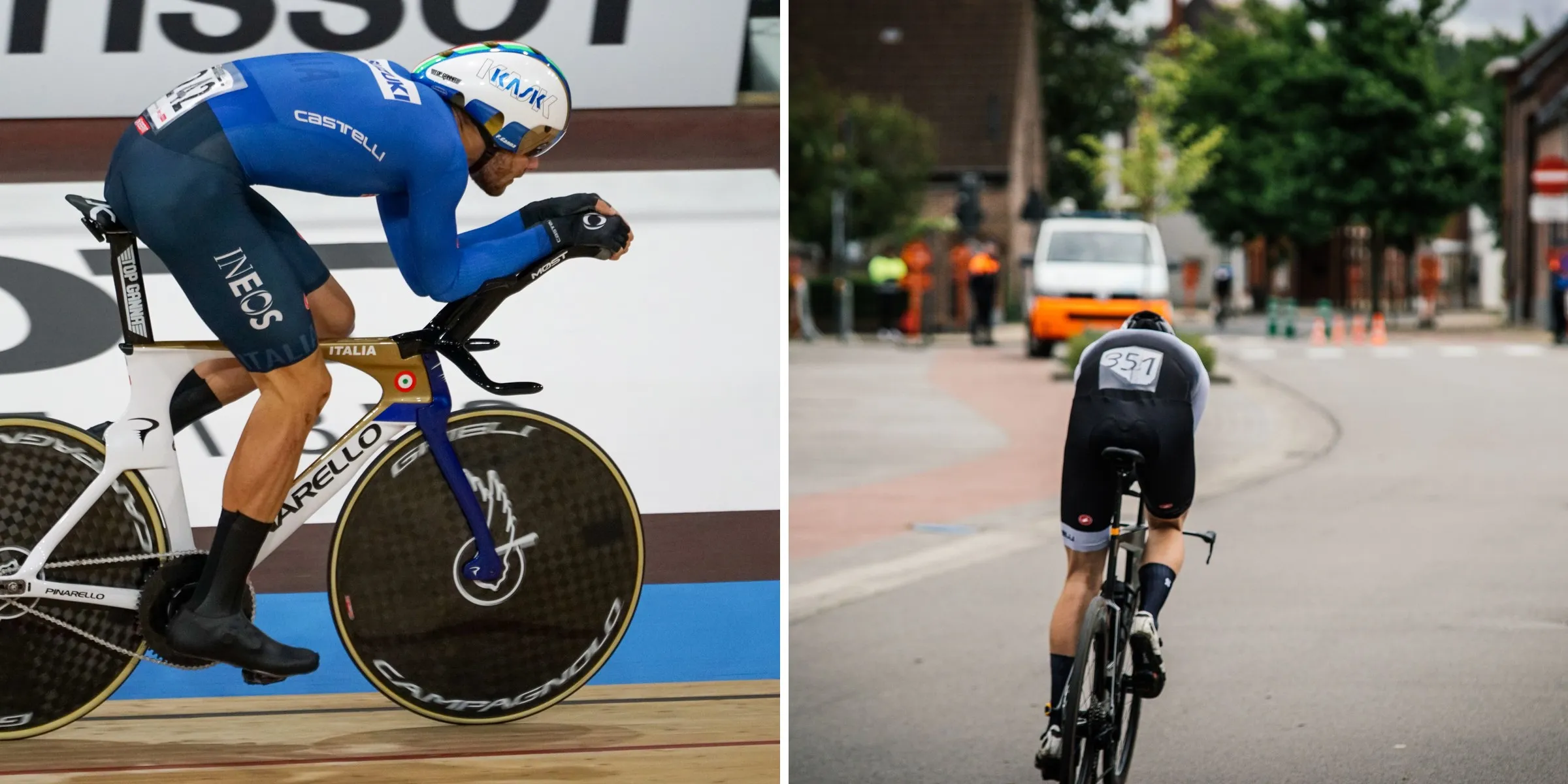

Those who know me (Gerben) well know I love cycling, and time trialing in particular. It is you and your bike against the wind (hopefully in your back) and a clock that does not care how you feel. The hour record is the purest form of it, one rider, one bike, 60 minutes on a track, no wheel to follow and nobody to blame. A few years ago Belgium had Victor Campenaerts taking it, 55.089 km in 2019 in Aguascalientes, Mexico, where the air is thin enough to be worth the trip.
Then 2022. Dan Bigham, a performance engineer at Ineos Grenadiers, rode the hour himself in August and took the record, 55.548 km, 459 m further than Campenaerts. Seven weeks later Filippo Ganna took it off him on the same track in Grenchen, 56.792 km, with Bigham’s numbers behind him. Around both of them stood an entourage, an aero engineer who knew the air, a physiologist who knew the legs, a mechanic who knew the bike, and so on. During the ride all of that boils down to one person with a lap board, showing the rider the only thing he can use mid-ride, faster, slower, hold. None of them could ride 56 km in an hour, and none of them had to.
So, would you rather have Ganna’s legs or his entourage? Look at the two records again. Bigham is a very good rider, Olympic silver in the team pursuit with Great Britain in 2024, who makes his living as an engineer. Ganna is one of the best time triallists of his generation. The same entourage got the engineer within 1.2 km of him, and got Ganna past every rider who had ever tried. The legs decide the last kilometre. The entourage decides whether you ride as hard as you can for an hour or as fast as you can, and those are two different sports.
Last week was about the systems around the robot, each playing its own match. This week is about the people on the floor, and what each of them knew and did not know at 06:02 when robot 4 stopped in aisle 37.
Most floors bought the legs, and that was the plan
When a site automates, one or two people learn the robot. The vendor trains them, they sit in on the commissioning, they are the ones who stay late the first weeks, and after a few months they know things nobody wrote down: which aisle jams at shift change, which pallets the robot struggles with, which “random” stop happens every time the same truck is late. They are the site’s super users, and every exception on the floor routes back to them. That is a sensible way to start (we would set it up the same way), because somebody has to understand the new machine, and one person can learn it faster than a department.
It also means the site is riding as hard as it can. The robot does what it was bought to do, full speed, every order, stop when the scanner says stop, and one person understands why. The test of that setup is a holiday. When the super user is away for a week, throughput shows it.
Everyone else got a red light and no reason
Here is our stop again, from the people’s side of the floor. At 06:02 robot 4 refuses a pallet in aisle 37 and three robots queue up behind it. The operator on the floor sees a robot standing still and, a quarter of an hour later, frees the pallet by hand, with no idea why the robot would not take it. The site manager sees throughput drop on the dashboard and concludes the site has too few robots. The automation engineer, when the ticket arrives, finds the jam on the fleet screen and reads a line of log meant for the vendor’s support desk. The person who runs the WMS, the warehouse management system that hands out the orders, never hears about it at all, and the WMS keeps sending orders into the aisle.
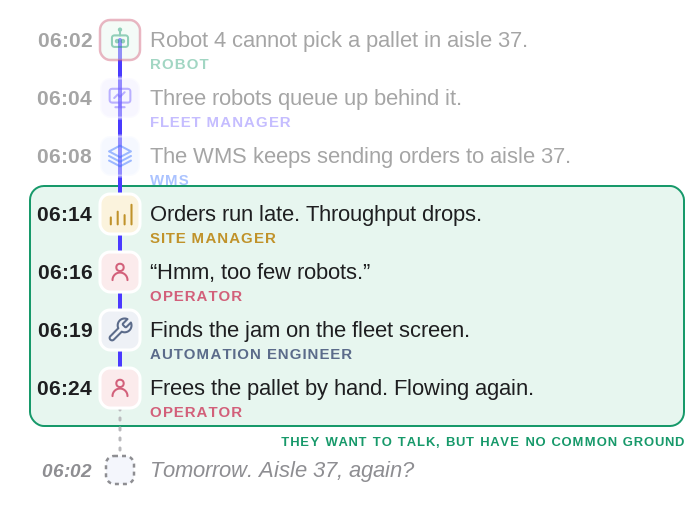
Each of them knows a piece of the robot’s hour that the others cannot see. The operator knows the pallet was wrapped past its edge, because she touched it. The engineer knows the robot’s scanner saw an obstacle, because he read it. The manager knows what the stop cost, because the dashboard counted it. Your operator has never seen the robot’s log, and your robot vendor has never done a night shift. Nobody in that building is wrong, and nobody has the lap board.
This is where resistance comes from, in my experience. Operators rarely object to a robot. They object to a machine that stops in front of them with a red light and no reason, three mornings a week, and to being the one who has to make it move again without knowing what it wanted. Give the same operator the sentence the robot wrote down, in her words, at the moment she walks up to it, and the resistance goes with the mystery.
A super user in every position, both ways
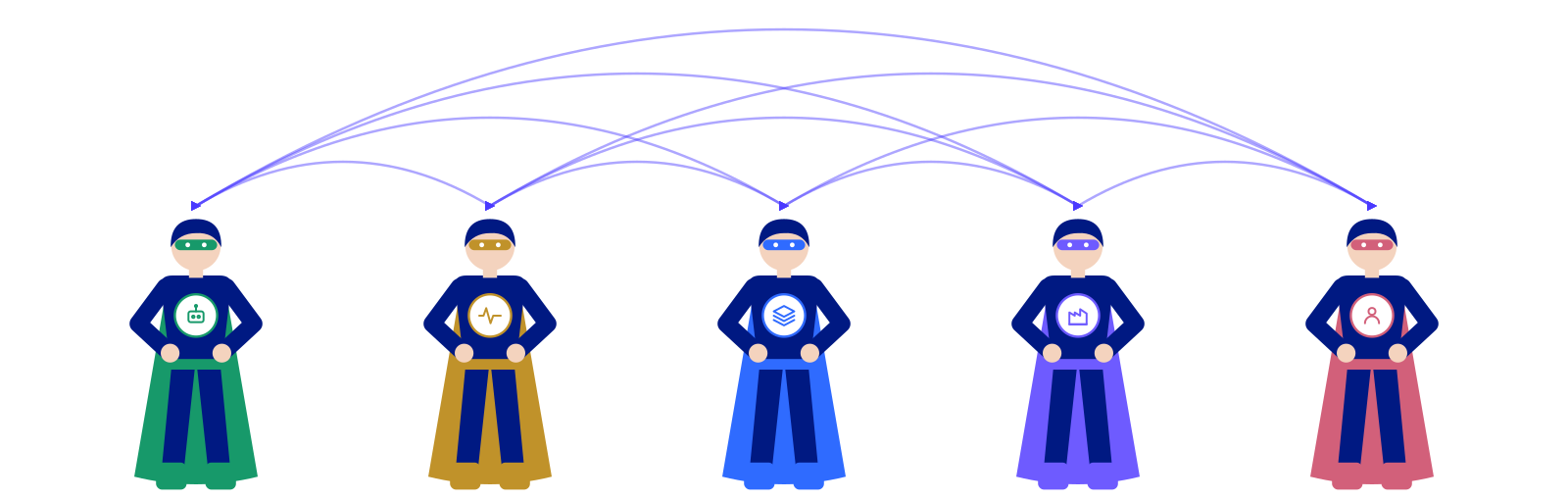
The usual fix is more training for the one super user, so that they understand the WMS rules and the Wi-Fi as well as the robot, which is asking Ganna to also do the aerodynamics. The velodrome shows the other way round. Every discipline in the entourage had its own expert, and each of them understood enough of the rider’s side to tell him something he could use. Bigham did not write Ganna’s plan from a spreadsheet. He rode the hour himself first, so that he knew what his own numbers feel like at minute 50.
That is what a super user is, I think. Not the one who knows the most, but the one who understands the other side. On a floor that means a super user in every position: the operator for the floor, the WMS admin for the orders, the maintenance engineer for the robot, IT for the network, the site manager for the numbers. Each of them already knows their own piece. What they lack is a view of the robot’s hour in their own words, and the robot’s vendor lacks a view of theirs. Both ways, because the engineer who understands the night shift fixes a different problem than the one who only reads the log.
What the lap board says to each of them
Nobody in the entourage shouted the whole plan at Ganna. The lap board showed him one thing, and the rest stayed with the people who could act on it. The floor works the same way when it works. The operator gets a stop she can clear on the spot, with the why: pallet overhang, left side, robot 4. The engineer gets the robot’s data next to the order it was running and what the WMS believed at the time, instead of a ticket that says “robot stopped again”. The site manager gets the trend, which stops keep coming back and who owns the fix. The WMS hears that the aisle is blocked and releases its orders elsewhere.
Thomas Vercammen, Logistic Automation & Innovation Manager at Toyota Material Handling Belgium, put it this way about the sites where ROCO holds up that board:
ROCO removes operational dependency on just a few automation experts. It gives local teams the actionable insights they need to troubleshoot in minutes rather than days.
How ROCO does that is for part 8 of this series. For now the point is the team. The people stay the same, and the problem arrives at the right desk with its history attached, in the words of the person sitting there.
Next week, we dive into what happens when you add more robot brands.